The vicuña (Vicugna vicugna) is one of the most iconic animals of the Andes and a powerful symbol of Peru’s natural heritage. Famous for producing the world’s finest and most luxurious natural fiber, this elegant wild camelid has lived in the high-altitude grasslands of South America for thousands of years. Revered by the Incas, protected by modern conservation programs, and admired by travelers from around the world, the vicuña represents the perfect balance between wildlife, culture, and sustainability.
Today, Peru is home to the largest population of vicuñas on Earth, making it one of the best destinations to observe these graceful animals in their natural habitat. Whether you encounter them along the route to Rainbow Mountain, in the vast landscapes of the Altiplano, or within protected national reserves, seeing a herd of vicuñas roaming freely is an unforgettable experience.
Beyond their beauty, vicuñas have one of the most remarkable conservation stories in the world. Once driven to the brink of extinction due to illegal hunting, they have recovered thanks to strict protection laws, community participation, and sustainable fiber harvesting practices that date back to Inca times.
In this complete guide, you’ll discover everything you need to know about the vicuña, including its habitat, behavior, diet, wool, conservation efforts, fascinating facts, and the best places to see these extraordinary animals during your trip to Peru.
Quick Facts About the Vicuña
| Feature | Information |
|---|---|
| Scientific Name | Vicugna vicugna |
| Family | Camelidae |
| Common Name | Vicuña |
| Native Region | Andes Mountains of Peru, Bolivia, Chile, Argentina and Ecuador |
| Habitat | High-altitude grasslands and puna ecosystems |
| Elevation | 3,200–5,000 meters (10,500–16,400 ft) |
| Average Weight | 35–50 kg (77–110 lbs) |
| Average Height | 80–100 cm (31–39 in) at the shoulder |
| Lifespan | 15–20 years in the wild |
| Diet | Native grasses, herbs and small shrubs |
| Conservation Status | Least Concern (IUCN) |
| Main Predator | Puma, Andean fox and feral dogs |
| Fiber Diameter | Around 12 microns |
| Fiber Production | Approximately 200–250 grams every 2–3 years |
| National Symbol | Featured on the Coat of Arms of Peru |
What Is a Vicuña?
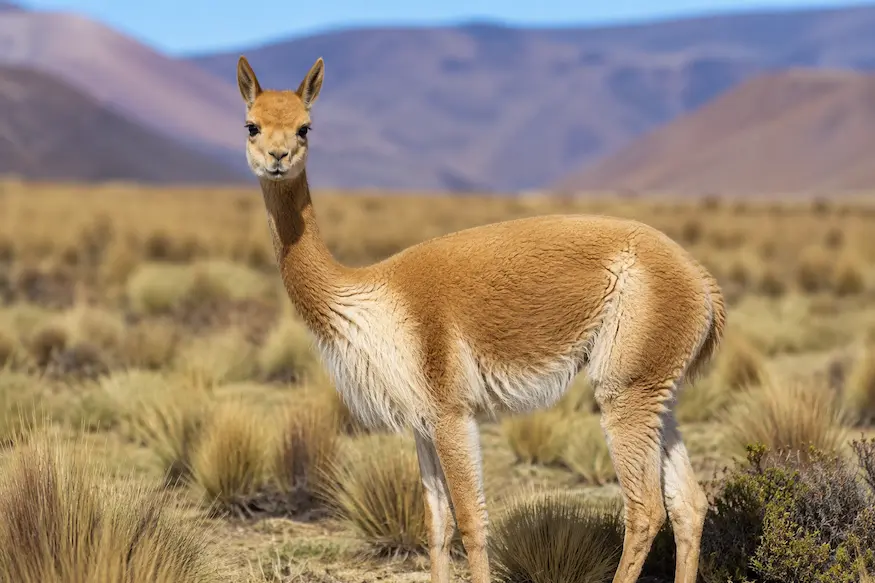
The vicuña is a wild South American camelid and the smallest member of the camel family. Although it shares ancestry with llamas, alpacas, and guanacos, the vicuña has remained largely wild throughout history and has never been fully domesticated.
Recognizable by its slender body, long neck, delicate face, and elegant movements, the vicuña has a distinctive cinnamon-colored coat with a bright white chest and underside. Its thick fleece protects it from freezing temperatures that often drop below 0°C (32°F) in the high Andes.
Unlike alpacas and llamas, which are commonly raised by Andean communities, vicuñas roam freely across remote mountain plateaus known as the puna. They live in family groups led by a dominant male that protects a territory containing grazing areas, water sources, and shelter from predators.
The vicuña’s most valuable feature is its incredibly fine wool, considered the softest and rarest natural fiber in the world. Because each animal produces only a small amount of fiber every few years, authentic vicuña garments are among the most exclusive luxury textiles available, often valued at thousands of dollars.
For the Incas, vicuñas were regarded as sacred animals belonging to the Sun God, Inti. Their wool was reserved exclusively for royalty, and harming a vicuña was strictly forbidden. This tradition of respect continues today through sustainable conservation programs that protect both the species and the Andean communities that depend on it.
Why Is the Vicuña Peru’s National Animal?
The vicuña is much more than a beautiful wild animal—it is a national symbol that reflects Peru’s extraordinary biodiversity, cultural history, and commitment to conservation. Its image proudly appears on the country’s Coat of Arms, representing the nation’s rich wildlife and natural resources.
During the Inca Empire, vicuñas held a sacred status. Rather than hunting them for meat or skin, the Incas developed a sophisticated conservation practice known as the Chaccu, a communal ceremony in which hundreds of people carefully surrounded herds, gently captured them, sheared their valuable fleece, and released them back into the wild unharmed. This sustainable tradition ensured that vicuña populations remained healthy for generations.
Following the Spanish conquest, uncontrolled hunting nearly wiped out the species. By the 1960s, fewer than 10,000 vicuñas remained across South America, placing them dangerously close to extinction.
Recognizing their ecological and cultural importance, Peru established strict conservation laws, protected reserves, and international agreements to safeguard the species. Local communities once again became active participants in protecting vicuñas while benefiting from the legal and sustainable sale of their highly prized fiber.
Today, Peru protects the world’s largest population of wild vicuñas and continues to lead international conservation efforts. The recovery of the species is widely regarded as one of the greatest wildlife conservation success stories in South America.
For Peruvians, the vicuña symbolizes harmony between humans and nature, respect for ancestral traditions, and the importance of preserving the country’s unique Andean ecosystems.
Why Are Vicuñas So Special?
Several characteristics make the vicuña unlike any other animal in South America:
- Produces the finest natural fiber in the world.
- Lives at elevations exceeding 5,000 meters (16,400 feet).
- Remains a truly wild camelid that cannot be domesticated like alpacas.
- Plays an essential ecological role in fragile Andean grasslands.
- Serves as Peru’s official national animal.
- Represents one of the world’s most successful wildlife conservation stories.
- Continues to be managed using sustainable traditions inherited from the Inca civilization.
Did You Know?
A single vicuña produces only about 200 grams (7 ounces) of usable fiber every two to three years. Because of this limited production and the extraordinary softness of its fleece, genuine vicuña garments are considered some of the most exclusive luxury textiles in the world, with scarves, coats, and suits often selling for several thousand dollars.
Vicuña vs Alpaca vs Llama vs Guanaco

South America is home to four native camelids: the vicuña, alpaca, llama, and guanaco. Although they belong to the same biological family and share a common ancestor, each species has evolved with unique characteristics, behaviors, and purposes.
Many travelers visiting Peru mistakenly identify every camelid they see as a llama or an alpaca. However, learning to distinguish these fascinating animals will enrich your journey through the Andes and help you better appreciate the region’s extraordinary biodiversity.
The vicuña is the smallest, wildest, and most delicate of the four species. It is also the ancestor of the domesticated alpaca and produces the world’s finest natural fiber.
Vicuña vs Alpaca

At first glance, vicuñas and alpacas may look similar, but they differ significantly in behavior, habitat, and appearance.
Vicuñas are wild animals that roam freely across Peru’s high-altitude grasslands. They have a slender build, long neck, narrow face, and elegant posture that allows them to move quickly across rugged terrain. Their coat is light cinnamon with a bright white chest and belly.
Alpacas, on the other hand, have been domesticated for more than 6,000 years. They are raised by Andean communities primarily for their soft wool and are commonly found grazing near villages and farms. Alpacas have a shorter face, rounder body, and much fluffier fleece than vicuñas.
Perhaps the greatest difference lies in their fiber. While alpaca wool is exceptionally soft and widely used in clothing, vicuña fiber is considerably finer, rarer, and more valuable.
Main Differences
| Feature | Vicuña | Alpaca |
|---|---|---|
| Status | Wild | Domesticated |
| Ancestor | Original wild species | Descended from vicuñas |
| Height | 80–100 cm | 90–100 cm |
| Weight | 35–50 kg | 55–70 kg |
| Fiber | Around 12 microns | Around 20–30 microns |
| Habitat | High Andes | Farms and communities |
| Personality | Shy and cautious | Calm and social |
| Commercial Use | Luxury fiber | Wool production |
Vicuña vs Llama
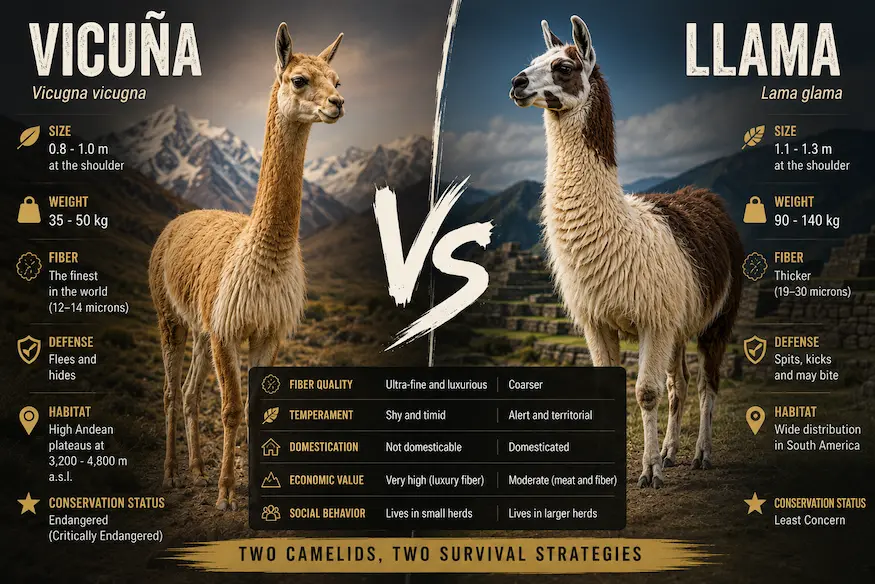
Llamas are the largest domesticated camelids in South America and have served Andean communities as pack animals for thousands of years.
Unlike the graceful and lightweight vicuña, llamas possess a sturdier build, broader head, larger ears, and significantly greater strength. They can carry loads of up to 30 kilograms during long mountain journeys, making them invaluable companions for rural communities.
Although llamas produce wool, its quality is much coarser than that of vicuñas, making it more suitable for ropes, blankets, rugs, and traditional textiles than luxury garments.
Main Differences
| Feature | Vicuña | Llama |
|---|---|---|
| Status | Wild | Domesticated |
| Average Weight | 35–50 kg | 130–200 kg |
| Primary Use | Fiber conservation | Pack animal and wool |
| Face | Slender | Broad |
| Ears | Short and pointed | Long and curved |
| Fiber Quality | Finest in the world | Coarse |
| Temperament | Very shy | Curious and confident |
Vicuña vs Guanaco
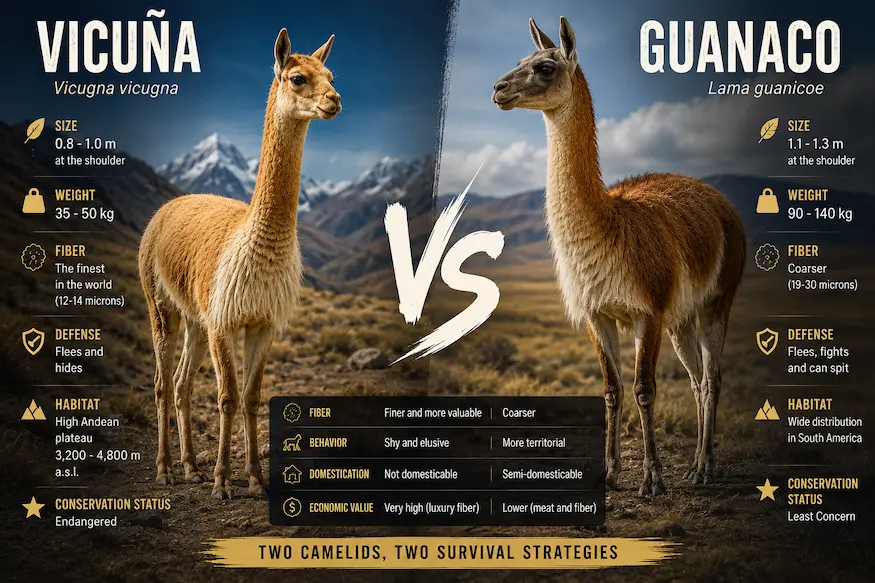
The guanaco is the wild camelid most closely related to the llama. Although less famous than the vicuña, guanacos inhabit vast regions of Argentina, Chile, Bolivia, and southern Peru.
Compared to vicuñas, guanacos are considerably larger and have a darker brown coat with a grayish face. They are highly adaptable and inhabit a wider range of ecosystems, from deserts and coastal plains to high mountains.
Their fiber is softer than llama wool but cannot match the extraordinary fineness of vicuña fleece.
Main Differences
| Feature | Vicuña | Guanaco |
|---|---|---|
| Size | Smallest camelid | Larger |
| Weight | 35–50 kg | 90–140 kg |
| Habitat | High Andes | Andes, Patagonia and deserts |
| Fiber | Finest | Medium quality |
| Conservation Value | Luxury fiber | Wildlife species |
| Color | Cinnamon and white | Brown with gray tones |
Which Camelid Produces the Finest Wool?
Among all four South American camelids, the vicuña produces by far the finest and most exclusive natural fiber on Earth.
Its fleece measures approximately 12 microns in diameter, making it significantly finer than cashmere, alpaca, mohair, or sheep’s wool. The fibers are incredibly soft, lightweight, warm, and breathable, qualities that have made vicuña wool one of the world’s most luxurious textiles for centuries.
Because each animal produces only a small amount of usable fiber every two to three years, authentic vicuña garments remain extremely rare and highly sought after.
Physical Characteristics of the Vicuña
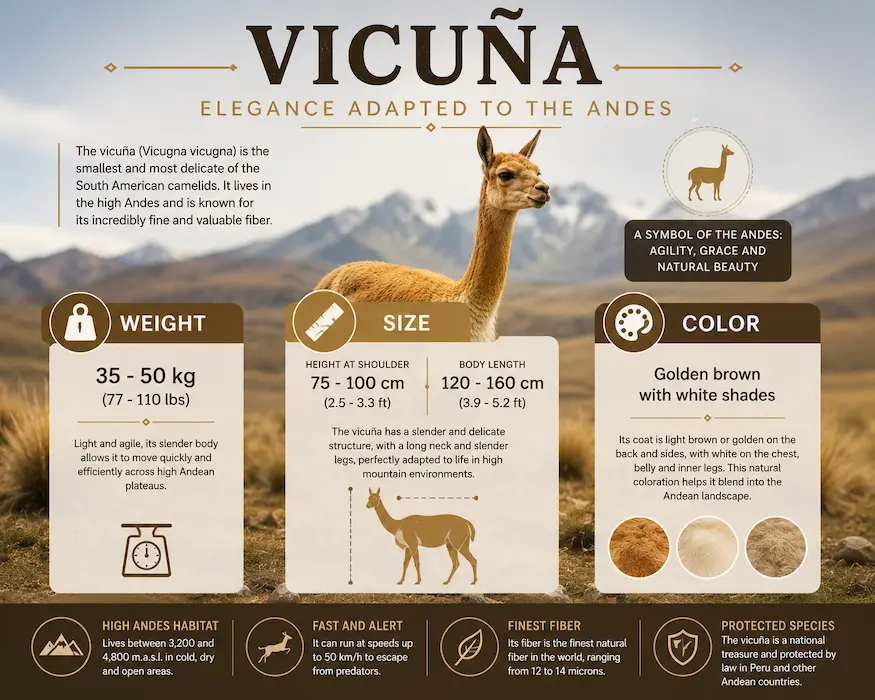
The vicuña is perfectly adapted to one of the harshest environments on Earth: the high Andes. Every aspect of its body has evolved to survive freezing temperatures, intense solar radiation, low oxygen levels, and rugged mountain landscapes.
Unlike the heavier llama or fluffy alpaca, the vicuña has a slim, athletic body designed for speed and endurance. Its elegant appearance allows it to move effortlessly across steep slopes and open grasslands while remaining alert to predators.
Size and Weight
Adult vicuñas are relatively small compared to other camelids.
Average measurements include:
- Height at the shoulder: 80–100 cm (31–39 inches)
- Body length: 1.4–1.6 meters (4.6–5.2 feet)
- Weight: 35–50 kilograms (77–110 pounds)
Their lightweight build helps reduce energy consumption in oxygen-poor environments found above 4,000 meters.
Coat Color
The vicuña has one of the most recognizable coats among South American mammals.
Its upper body displays a rich golden-cinnamon color that blends perfectly with the dry Andean grasslands. In contrast, the chest, neck, belly, and inner legs are covered with bright white, silky fibers that provide excellent insulation.
This natural coloration also acts as camouflage, making it more difficult for predators to spot the animals across the puna.
The World’s Finest Fur
The vicuña’s fleece is extraordinarily dense and soft.
Each hair is incredibly thin, allowing the animal to retain body heat even during freezing Andean nights, when temperatures frequently fall below -10°C (14°F).
Unlike sheep, vicuñas do not produce large quantities of wool. Instead, they invest in producing exceptionally high-quality fibers that offer maximum insulation with minimal weight.
Adaptations for High Altitudes
Living between 3,200 and 5,000 meters (10,500–16,400 feet) requires remarkable physiological adaptations.
Vicuñas possess:
- A highly efficient cardiovascular system.
- Large lungs for improved oxygen intake.
- Blood rich in red blood cells.
- Strong, lightweight legs for rocky terrain.
- Soft padded feet that minimize erosion of fragile grasslands.
- Thick eyelashes that protect their eyes from dust and intense sunlight.
These adaptations allow them to thrive where few large mammals can survive.
Teeth That Never Stop Growing
One unusual feature of the vicuña is its continuously growing lower incisors.
Like rodents, these teeth grow throughout the animal’s lifetime. Constant grazing naturally wears them down, preventing excessive growth and allowing vicuñas to feed efficiently on the tough grasses of the Andes.
Habitat and Distribution

Vicuñas inhabit some of the highest ecosystems on the planet.
They are native to the Central Andes of South America, where they live in open grasslands known as the puna—a unique environment characterized by cold temperatures, intense sunlight, seasonal rainfall, and strong winds.
Unlike forests or tropical jungles, the puna consists mainly of native grasses, wetlands, volcanic plains, and snow-capped mountains.
These landscapes provide the perfect conditions for vicuñas to graze, reproduce, and maintain healthy populations.
Countries Where Vicuñas Live

Today, wild vicuñas are found in five South American countries:
- Peru
- Bolivia
- Chile
- Argentina
- Ecuador (small reintroduced populations)
Peru is home to approximately half of the world’s wild vicuña population, making it the most important country for the conservation of the species.
Altitude Range
Most vicuñas live between:
3,200 and 5,000 meters (10,500–16,400 feet) above sea level.
Some herds have even been observed at elevations exceeding 5,200 meters, where oxygen levels are less than half of those at sea level.
Preferred Ecosystems
Vicuñas prefer open landscapes where they can detect predators from great distances.
Typical habitats include:
- High Andean grasslands
- Puna ecosystems
- Wetlands (bofedales)
- Volcanic plateaus
- Mountain valleys
- Cold desert plains
They generally avoid dense forests and steep rocky cliffs.
Best Places to See Vicuñas in Peru
Peru offers countless opportunities to observe vicuñas in the wild. Some of the best locations include:
- Pampa Galeras National Reserve (Ayacucho)
- Salinas y Aguada Blanca National Reserve (Arequipa)
- La Raya Pass (Cusco–Puno route)
- Ausangate Mountain
- Rainbow Mountain (Vinicunca)
- Palccoyo Rainbow Mountain
- Salkantay region
- Lucanas Province
- Chumbivilcas Highlands
Many visitors encounter wild vicuñas while traveling between Cusco and Puno or during trekking adventures through the Peruvian Andes.
Behavior and Social Structure
The vicuña is an intelligent, highly social, and territorial animal that has developed remarkable survival strategies to thrive in one of the world’s most challenging environments. Every aspect of its behavior—from grazing and communication to reproduction and predator avoidance—has evolved over thousands of years in the harsh Andean highlands.
Unlike domesticated alpacas and llamas, vicuñas remain completely wild. They are naturally cautious and avoid human contact whenever possible, making wildlife encounters especially rewarding for travelers exploring Peru’s mountains.
Family Groups
Most vicuñas live in small family groups composed of:
- One dominant adult male
- Five to fifteen females
- Their young (crias)
The dominant male is responsible for defending the group’s territory from rival males and protecting females from predators. He constantly patrols the grazing area, remaining alert to any potential danger.
When another male approaches, territorial disputes usually involve loud vocalizations, chasing, and displays of dominance rather than serious physical fights.
Bachelor Groups
Young males that have not yet established a territory form separate bachelor herds.
These groups may contain anywhere from a few individuals to more than twenty animals. As they mature, they eventually challenge dominant males in an attempt to establish their own family groups.
This natural social structure helps maintain healthy genetic diversity across wild populations.
Territorial Behavior
Unlike guanacos, vicuñas defend relatively small territories throughout the year.
A typical territory includes:
- Grazing areas
- Water sources
- Resting zones
- Safe observation points
The dominant male continuously patrols these areas and warns intruders through alarm calls and aggressive posturing.
Although territorial, vicuñas rarely engage in violent combat. Most confrontations end once one male retreats.
Communication
Vicuñas communicate using a combination of sounds, body language, and scent.
Common forms of communication include:
Vocalizations
Vicuñas emit soft whistles and high-pitched calls to:
- Warn the herd of predators
- Maintain contact while grazing
- Signal distress
- Call their young
Body Language
Their posture also communicates important information.
For example:
- Raised head = alertness
- Ears forward = curiosity
- Running in formation = escape response
- Tail position = emotional state

Because they rely heavily on visual signals, members of the herd can react almost instantly when danger appears.
Communal Latrines
One of the most fascinating behaviors of vicuñas is the use of communal dung piles.
Rather than leaving droppings randomly across the landscape, every member of the herd deposits waste in the same location.
Scientists believe these communal latrines serve several purposes:
- Territorial marking
- Communication between neighboring groups
- Reduction of parasite spread
- Maintenance of grazing areas
This unusual behavior is shared with several other camelid species but is especially well developed in vicuñas.
Daily Activity
Vicuñas follow a predictable daily routine.
Early Morning
They begin grazing shortly after sunrise when temperatures are still cool.
Midday
During the warmest hours, they rest or chew cud while remaining alert.
Afternoon
They resume feeding before sunset.
Night
The herd sleeps together in open areas where predators can be detected quickly.
Remaining in open terrain provides excellent visibility and reduces the risk of surprise attacks.
Are Vicuñas Aggressive?
No.
Despite being territorial, vicuñas are generally shy and peaceful animals.
Their first response to danger is almost always escape rather than confrontation.
When approached by humans, they usually:
- Observe briefly
- Become cautious
- Run away if people continue approaching
Because of this natural behavior, visitors should always observe vicuñas from a respectful distance and avoid disturbing them.
What Do Vicuñas Eat?
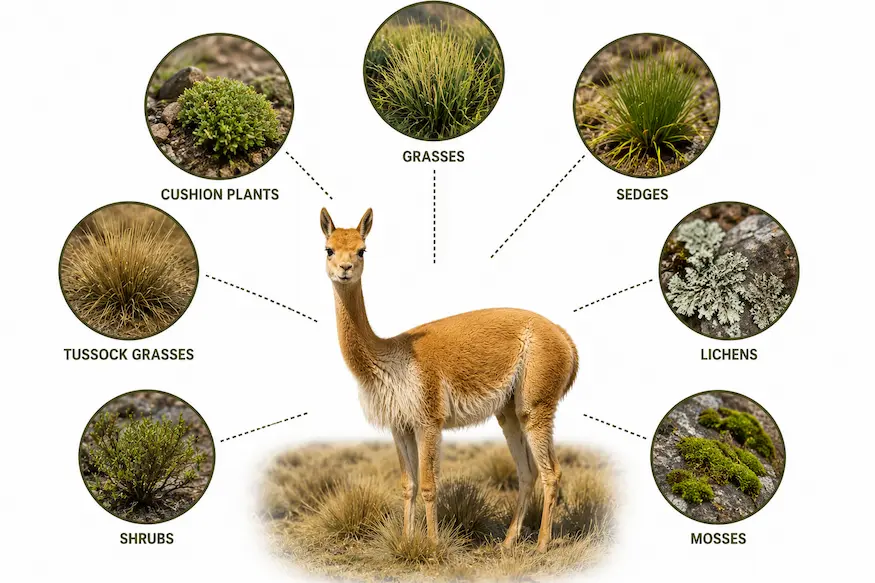
Vicuñas are herbivores perfectly adapted to the sparse vegetation of the Andean puna.
Unlike livestock that depend on nutrient-rich pastures, vicuñas survive on hardy native plants that flourish at extreme elevations where few other large mammals can live.
Their specialized digestive system enables them to extract maximum nutrition from tough mountain grasses while consuming relatively little food.
Main Diet
The diet of wild vicuñas includes:
- Native puna grasses
- Ichu grass (Stipa ichu)
- Small flowering plants
- Herbs
- Mosses
- Shrubs
- Tender shoots
- Wetland vegetation
They selectively graze the youngest and most nutritious parts of plants without uprooting them.
This feeding strategy allows vegetation to regenerate naturally and contributes to the long-term health of Andean ecosystems.
Water Requirements
Although vicuñas obtain some moisture from plants, they still require regular access to fresh water.
Many herds establish territories around:
- Mountain streams
- Springs
- Wetlands (bofedales)
- Seasonal ponds
During the dry season, these water sources become especially important for survival.
Efficient Grazers
Unlike sheep or goats, vicuñas possess soft padded feet instead of hard hooves.
This adaptation offers several ecological advantages:
- Prevents soil erosion
- Protects fragile grasslands
- Reduces damage to wetlands
- Helps preserve native vegetation
Their grazing behavior is considered one reason why vicuñas are compatible with sustainable conservation and ecosystem management.
Reproduction and Life Cycle
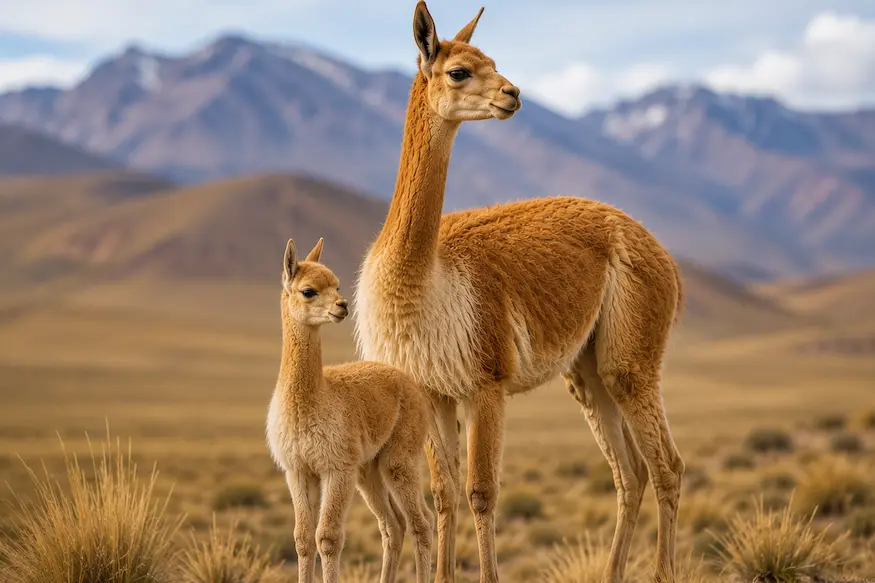
The reproductive cycle of the vicuña is closely linked to the seasonal climate of the Andes.
Timing births to coincide with the rainy season ensures that newborns have access to abundant vegetation during the first months of life.
Mating Season
Breeding generally occurs between:
March and May
During this period, dominant males become more protective of their territories and females.
Competition between neighboring males increases, although serious fights remain uncommon.
Gestation
Female vicuñas remain pregnant for approximately:
11 months
This relatively long gestation allows calves to be well developed at birth.
Birth
Most births occur between:
February and April
A female usually gives birth to a single calf.
Twins are extremely rare.
Within just one hour of birth, the newborn is already capable of standing and walking alongside its mother.
This rapid development greatly improves survival in open habitats where predators are always present.
Raising the Young
Mothers nurse their calves for around:
6–8 months
During this time, young vicuñas remain close to their mothers while gradually learning:
- Grazing behavior
- Predator awareness
- Social interactions
- Territory boundaries
The dominant male also contributes by protecting the entire family group from potential threats.
Sexual Maturity
Females generally reach sexual maturity at around:
2 years
Males mature slightly later.
Young males eventually leave their family groups and join bachelor herds before attempting to establish territories of their own.
Lifespan
Wild vicuñas typically live:
15–20 years
Individuals living in protected reserves often enjoy longer lifespans due to reduced hunting pressure and healthier habitats.
Natural Predators
Despite their speed and vigilance, vicuñas face several natural threats across the Andes.
Their primary predators include:
- Puma
- Andean fox
- Feral dogs
- Occasionally large birds of prey attacking newborn calves
The greatest historical threat, however, has always been humans through illegal hunting.
Survival Adaptations
Over thousands of years, vicuñas have developed remarkable adaptations that allow them to survive at extreme altitudes.
These include:
Exceptional Vision
Their large eyes provide excellent long-distance visibility, allowing them to detect predators across open landscapes.
Incredible Speed
Vicuñas can sprint at speeds approaching 50 km/h (31 mph), making them one of the fastest mammals in the Andes.
Efficient Respiration
Large lungs and oxygen-rich blood enable them to thrive where oxygen levels are significantly lower than at sea level.
Superior Insulation
Their ultra-fine fleece traps warm air close to the body while remaining lightweight, protecting them from freezing nighttime temperatures.
Social Cooperation
Living in organized family groups increases the chances of detecting predators early, giving the herd time to escape before danger approaches.
Vicuña Wool: The World’s Finest Natural Fiber
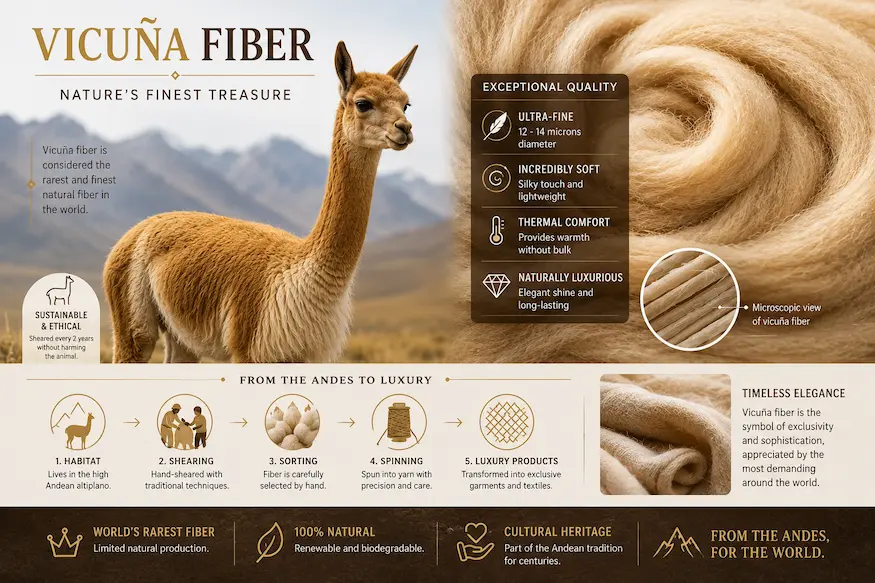
Among all natural fibers produced by animals, none is more luxurious, exclusive, or valuable than vicuña wool. Often referred to as the “Fiber of the Gods,” it has been prized for thousands of years due to its extraordinary softness, rarity, and exceptional thermal properties.
Unlike sheep, alpacas, or cashmere goats, vicuñas are wild animals that cannot be commercially farmed. Every strand of their fleece is obtained through carefully regulated conservation programs that prioritize the animals’ welfare while supporting Andean communities.
Today, authentic vicuña garments are considered some of the most prestigious luxury textiles in the world, worn by collectors, royalty, and those seeking the finest natural fabrics available.
Why Is Vicuña Wool So Expensive?
The extraordinary value of vicuña wool comes from a unique combination of rarity, quality, and sustainable production.
Several factors contribute to its exceptional price.
Extremely Fine Fiber
The diameter of vicuña fiber averages 12 microns, making it one of the finest natural fibers ever measured.
For comparison:
| Fiber | Average Diameter |
|---|---|
| Vicuña | 12 microns |
| Cashmere | 14–19 microns |
| Baby Alpaca | 18–22 microns |
| Merino Wool | 18–24 microns |
| Sheep Wool | 25–40 microns |
Even a difference of just a few microns significantly affects softness, flexibility, and comfort against the skin.
Very Limited Production
Each vicuña produces an incredibly small amount of usable fiber.
A healthy adult yields approximately:
200–250 grams (7–9 ounces)
every two to three years.
After cleaning and processing, the amount available for manufacturing becomes even smaller.
This extremely limited supply naturally increases its value.
Wild, Not Farmed
Unlike alpacas or sheep, vicuñas cannot be permanently domesticated.
They continue living freely across the Andes and are only captured briefly during authorized conservation events.
This means production can never be industrialized.
Every kilogram of fiber depends on healthy wild populations and sustainable wildlife management.
Difficult Collection Process
Harvesting vicuña wool requires:
- Large teams of trained people.
- Veterinary supervision.
- Government authorization.
- Community participation.
- Specialized handling techniques.
Every animal is carefully released after shearing.
No killing is involved.
The complexity of this process contributes significantly to the fiber’s exclusivity.
Exceptional Warmth
Despite being incredibly lightweight, vicuña fiber provides outstanding thermal insulation.
Its microscopic hollow structure traps warm air while remaining breathable.
This allows garments to:
- Keep the body warm in cold weather.
- Prevent overheating indoors.
- Feel exceptionally light.
- Remain comfortable in a wide range of temperatures.
Natural Softness
Many luxury fibers become softer after processing.
Vicuña wool is naturally soft from the beginning.
Its silky texture often surprises people who touch it for the first time.
Because the fibers are so fine, garments drape beautifully and feel almost weightless.
How Much Does Vicuña Wool Cost?
Authentic vicuña products are among the most expensive textile items in the world.
Although prices vary depending on craftsmanship and brand, premium garments often cost:
| Product | Typical Price Range |
|---|---|
| Scarf | US$1,000–3,000 |
| Sweater | US$2,000–5,000 |
| Jacket | US$5,000–10,000 |
| Coat | US$8,000–20,000+ |
| Luxury Suit | US$15,000–30,000+ |
Because counterfeit products exist, genuine vicuña garments are usually sold only through certified luxury manufacturers.
Why Can’t Vicuñas Be Farmed?
This is one of the questions travelers ask most often.
Unlike alpacas and llamas, vicuñas retain strong wild instincts.
Attempts to permanently confine them generally result in:
- Chronic stress
- Lower reproduction rates
- Poor health
- Behavioral problems
For this reason, conservation experts agree that the best way to protect the species is to allow them to remain free while harvesting their fiber only through carefully managed programs.
This sustainable approach benefits both wildlife and local communities.
The Ancient Chaccu Tradition
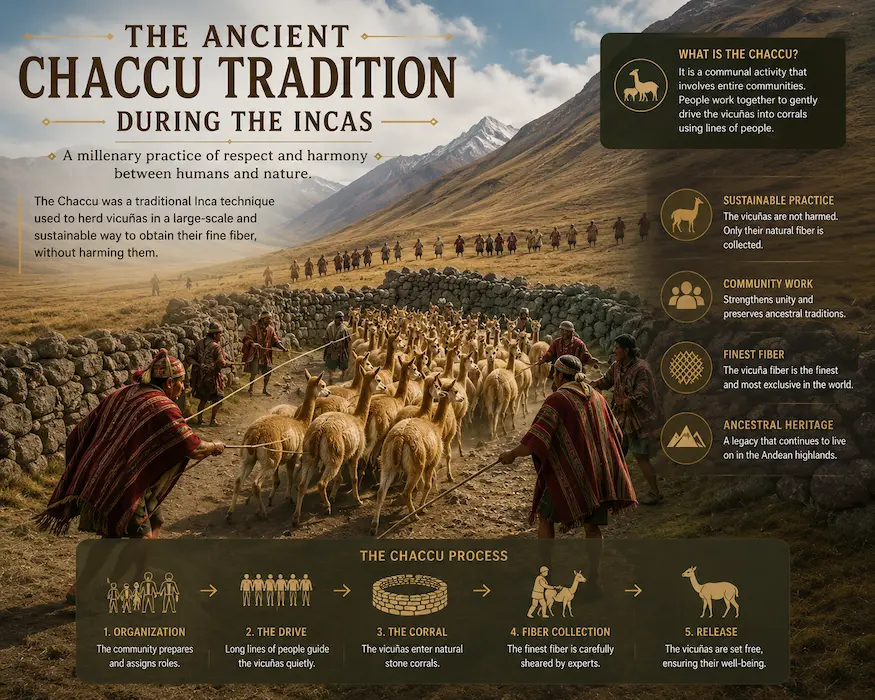
Long before modern wildlife conservation existed, the Incas developed an ingenious method for obtaining vicuña fiber without harming the animals.
This ceremony became known as the Chaccu.
Today, it remains one of Peru’s most remarkable cultural traditions and serves as a model for sustainable wildlife management.
What Is the Chaccu?
The Chaccu is a traditional communal roundup in which hundreds of people work together to gently surround wild vicuñas across large areas of the Andean grasslands.
Using colorful ropes decorated with ribbons and flags, participants slowly guide the animals toward temporary corrals.
Once inside, each vicuña is:
- Examined by specialists.
- Carefully restrained.
- Shorn by trained professionals.
- Released back into the wild within minutes.
No animals are sacrificed.
The entire process is designed to minimize stress while protecting the long-term health of the population.
The Chaccu During the Inca Empire
For the Incas, vicuñas were considered sacred animals belonging to Inti, the Sun God.
Only members of the royal family were permitted to wear garments made from vicuña fiber.
Killing a vicuña was strictly forbidden.
Communities gathered periodically to perform the Chaccu, ensuring that valuable fleece could be collected without reducing wild populations.
This conservation philosophy was centuries ahead of its time.
The Modern Chaccu
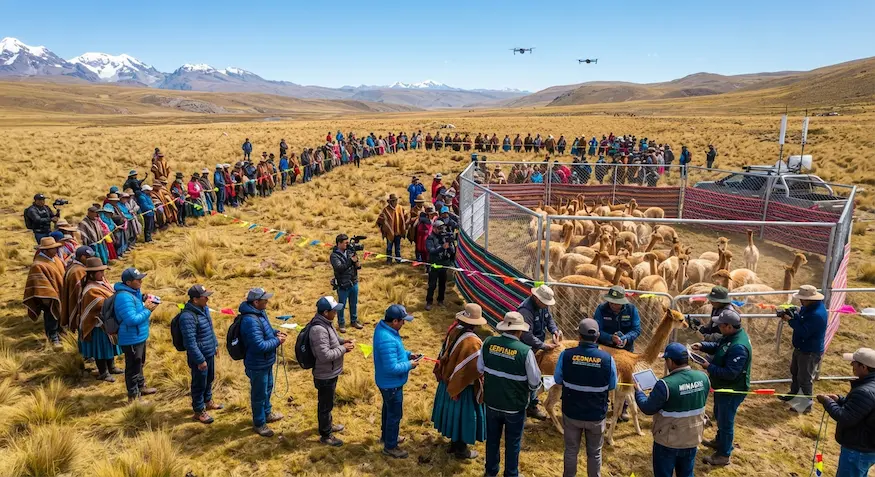
Today, the tradition continues in many Andean communities, especially in protected areas such as Pampa Galeras National Reserve.
The event combines:
- Wildlife conservation
- Indigenous traditions
- Scientific management
- Sustainable economic development
The fiber collected during these events provides an important source of income for rural communities while encouraging the protection of wild vicuñas.
Is Vicuña Wool Ethical?
Yes—when it comes from certified sustainable sources.
Modern regulations ensure that:
- Animals are never killed for their fiber.
- Shearing occurs only at appropriate intervals.
- Wildlife populations remain healthy.
- Local communities receive economic benefits.
- Illegal hunting is actively prevented.
Purchasing certified vicuña products helps support long-term conservation programs throughout the Andes.
How Can You Tell If Vicuña Wool Is Real?
Because of its extraordinary value, counterfeit products occasionally appear on the market.
Authentic vicuña garments typically have:
- Official certification.
- Traceable origin.
- Exceptional softness.
- Extremely lightweight feel.
- Very high prices.
- Sales through reputable luxury retailers.
If a product labeled as vicuña seems unusually inexpensive, it is almost certainly not genuine.
Can Tourists Watch a Chaccu Ceremony?
Yes.
Several Andean communities organize annual Chaccu festivals where visitors can observe this extraordinary tradition firsthand.
These events provide a unique opportunity to learn about:
- Inca heritage.
- Wildlife conservation.
- Traditional textile production.
- Community-based tourism.
Watching a Chaccu is considered one of the most authentic cultural and wildlife experiences available in the Peruvian Andes.
Did You Know?
Although vicuña wool is the most expensive natural fiber in the world, each animal contributes less than a quarter of a kilogram of fleece every two to three years. This remarkable scarcity—combined with centuries of cultural significance and strict conservation practices—is what makes vicuña garments true symbols of luxury.
Conservation: From the Brink of Extinction to a Global Success Story
The recovery of the vicuña is considered one of the world’s greatest wildlife conservation success stories. Today, thousands of these graceful animals roam freely across the Andes, but just a few decades ago, the species faced a very different reality.
Throughout history, the vicuña has been admired for its incredibly soft and valuable fleece. Unfortunately, this same characteristic nearly led to its disappearance.
Why Were Vicuñas Almost Extinct?
Following the Spanish conquest of South America, the traditional Inca system of protecting vicuñas gradually disappeared.
For centuries, uncontrolled hunting became widespread because of the enormous value of their wool. Unlike the Incas, who carefully sheared the animals and released them, many hunters simply killed vicuñas to obtain their fleece more quickly.
By the middle of the 20th century, illegal hunting had devastated wild populations.
By the 1960s, experts estimated that fewer than 10,000 vicuñas remained across the Andes, placing the species dangerously close to extinction.
How Were Vicuñas Saved?
Recognizing the urgent need for action, Peru and neighboring countries launched large-scale conservation programs.
These efforts included:
- Creating protected natural reserves.
- Enforcing strict anti-poaching laws.
- Prohibiting illegal trade.
- Supporting traditional Chaccu ceremonies.
- Involving local Andean communities in conservation.
- Monitoring wild populations through scientific research.
This collaborative approach transformed the future of the species.
Current Conservation Status
Thanks to decades of protection, the vicuña has made an extraordinary recovery.
Today, the species is classified as Least Concern by the International Union for Conservation of Nature (IUCN), although continuous monitoring remains essential.
Peru protects the largest wild population in the world, making the country a global leader in vicuña conservation.
Why Vicuñas Are Important to the Andean Ecosystem
Vicuñas play an essential role in maintaining the ecological balance of the high Andes.
Unlike livestock with hard hooves, vicuñas have soft padded feet that minimize soil erosion and help preserve fragile mountain grasslands.
Their selective grazing also encourages healthy plant growth without damaging native vegetation.
Because they are well adapted to the puna ecosystem, vicuñas are considered an indicator species of a healthy Andean environment.
Where to See Vicuñas in Peru
One of the greatest advantages of traveling through the Peruvian Andes is the opportunity to observe wild vicuñas in their natural habitat.
Unlike animals kept in zoos or wildlife parks, vicuñas in Peru live freely across vast mountain landscapes, offering unforgettable wildlife encounters.
1. Pampa Galeras National Reserve (Ayacucho)

Often considered the best place in Peru to see vicuñas, Pampa Galeras National Reserve was created specifically to protect the species.
Thousands of animals inhabit its high-altitude grasslands, and visitors may also witness the traditional Chaccu ceremony during certain times of the year.
Highlights
- Largest protected vicuña reserve.
- Annual Chaccu festival.
- Excellent wildlife photography.
- Conservation center.
2. Salinas y Aguada Blanca National Reserve (Arequipa)
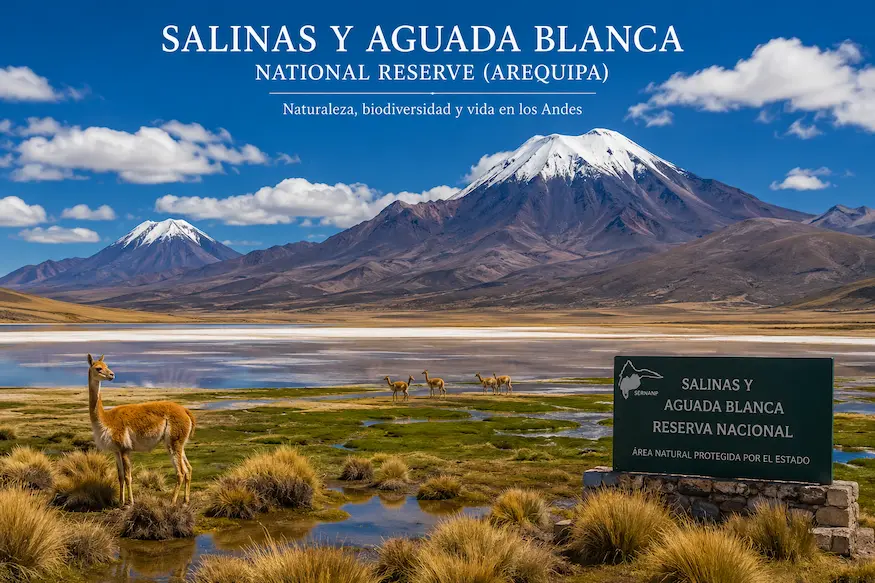
Located between Arequipa and Colca Canyon, this reserve is home to large herds of vicuñas as well as flamingos, Andean foxes, and numerous bird species.
The open volcanic landscape creates spectacular opportunities for photography.
3. Rainbow Mountain (Vinicunca)

Many travelers are surprised to encounter wild vicuñas while hiking toward Rainbow Mountain.
Because the trail crosses high puna grasslands above 4,500 meters, the area provides excellent habitat for these elegant animals.
Early morning departures usually offer the best wildlife sightings.
4. Ausangate Trek
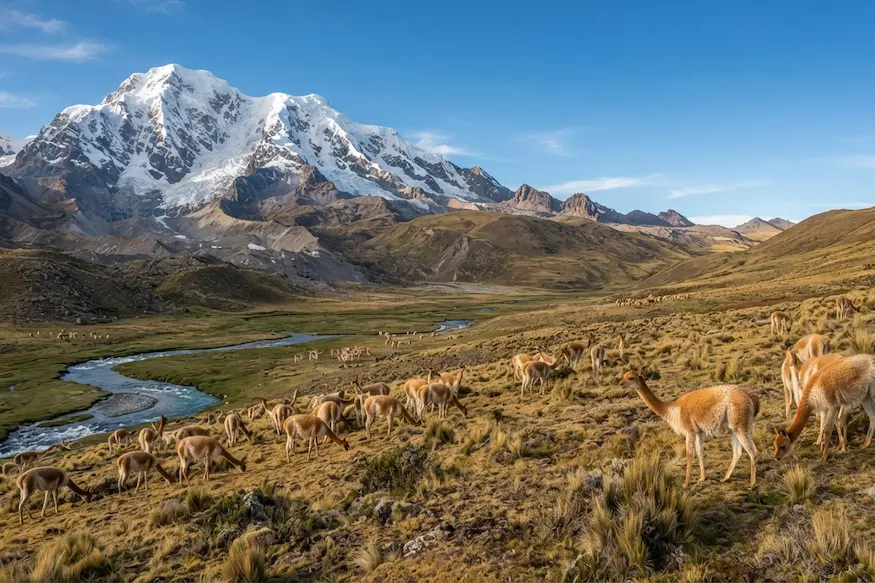
The Ausangate region is one of Peru’s richest wildlife areas.
During multi-day treks, hikers frequently observe:
- Wild vicuñas.
- Alpacas.
- Llamas.
- Vizcachas.
- Andean birds.
The dramatic scenery makes this one of the country’s finest destinations for nature lovers.
5. La Raya Pass
Located between Cusco and Puno, La Raya Pass is one of the easiest places to spot vicuñas without hiking.
Travelers on scenic bus or train journeys often see small family groups grazing peacefully beside the road.
6. Salkantay Region
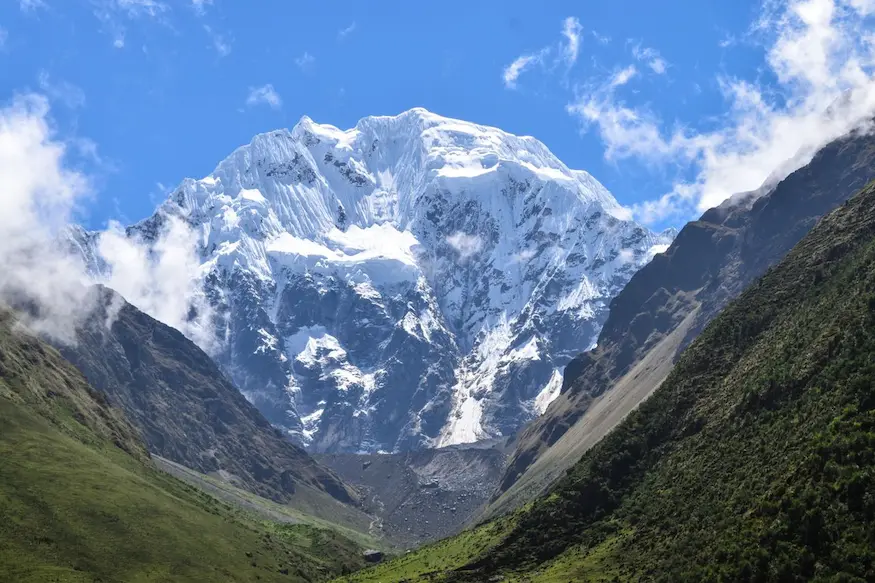
Although best known for its spectacular trekking route to Machu Picchu, the high-altitude sections of the Salkantay Trek occasionally offer opportunities to observe wild vicuñas.
Sightings are most common in open grasslands during the early morning.
Best Time to See Vicuñas
Vicuñas can be observed throughout the year, but weather conditions greatly influence visibility.
Dry Season (May to October)
The dry season offers the best wildlife viewing conditions.
Advantages include:
- Clear blue skies.
- Excellent visibility.
- Comfortable trekking weather.
- Better photography.
- Easier access to high-altitude reserves.
This is generally considered the best time to observe vicuñas.
Rainy Season (November to April)
Although rainfall is more frequent, the Andes become exceptionally green during these months.
Advantages include:
- Beautiful landscapes.
- Fewer tourists.
- Active wildlife.
- Excellent scenery for photographers.
Morning excursions remain the best option because afternoons often bring clouds or showers.
Responsible Wildlife Watching
Observing vicuñas in the wild is a privilege, and responsible tourism helps ensure these animals remain protected for future generations.
When visiting their habitat:
- Maintain a respectful distance.
- Never attempt to feed wild animals.
- Avoid loud noises.
- Stay on marked trails.
- Never chase or approach a herd.
- Use binoculars or a zoom lens for close-up views.
- Follow your guide’s instructions.
Ethical wildlife observation minimizes stress on the animals and contributes to long-term conservation.
25 Fascinating Facts About Vicuñas
- The vicuña is Peru’s national animal.
- It belongs to the camel family.
- It is the smallest South American camelid.
- The alpaca was domesticated from the wild vicuña.
- Vicuñas live above 3,200 meters (10,500 feet).
- They produce the world’s finest natural fiber.
- Their fleece measures about 12 microns in diameter.
- Each animal is shorn only every two to three years.
- They remain completely wild.
- Vicuñas can run at speeds of up to 50 km/h (31 mph).
- They communicate using whistles and body language.
- Family groups are led by a single dominant male.
- Young males form bachelor herds.
- They use communal latrines to mark territory.
- Their padded feet protect fragile mountain ecosystems.
- They are herbivores that feed mainly on native grasses.
- Their thick fleece protects them from freezing temperatures.
- They have continuously growing lower incisors.
- The Incas considered them sacred animals.
- Ancient Peruvians collected their wool through the Chaccu ceremony.
- Illegal hunting nearly caused their extinction.
- Peru protects the largest wild population on Earth.
- Certified vicuña wool supports conservation and local communities.
- They are among the most photographed wild animals in the Andes.
- Seeing a wild vicuña is one of the highlights of traveling through Peru’s highlands.
Conclusion
The vicuña is far more than a beautiful animal roaming the Peruvian Andes. It represents centuries of history, remarkable adaptation to one of the world’s harshest environments, and one of the greatest conservation success stories ever achieved.
Whether you admire its extraordinary fiber, learn about the ancient Chaccu tradition, or encounter a wild herd while exploring Rainbow Mountain, Ausangate, or the Sacred Valley, the vicuña offers a unique connection to Peru’s natural and cultural heritage.
As travelers, we have the opportunity to appreciate these incredible animals responsibly by supporting ethical tourism, respecting protected habitats, and choosing experiences that contribute to the conservation of Peru’s extraordinary wildlife.
Extras: Animated vicuña drawing for Pinter