

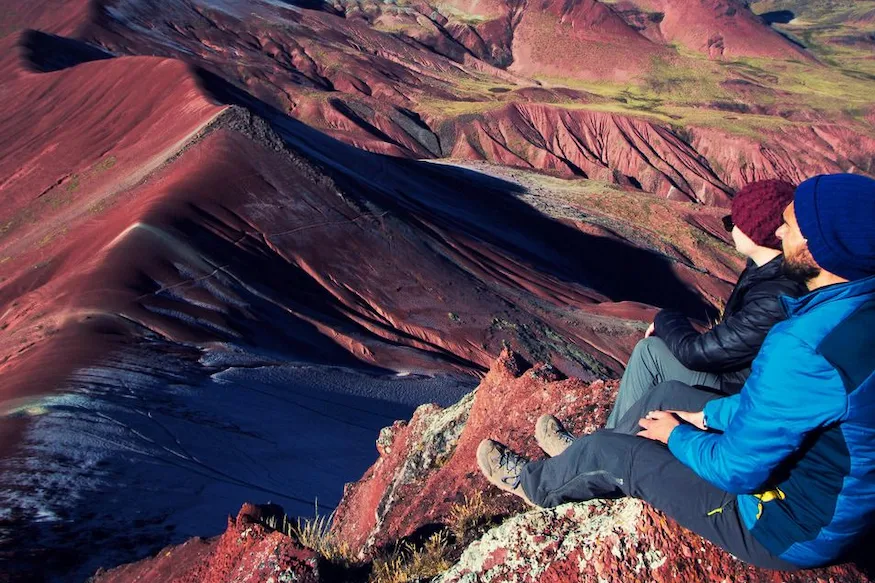

While thousands of travelers make their way to Rainbow Mountain, only a portion continue toward Red Valley. That makes it an excellent addition for hikers who want to see more of the region and experience a quieter side of the Peruvian Andes.
This guide covers everything you need to know about visiting Red Valley in Peru, including its location, altitude, landscape, history, hiking conditions, weather, entrance fees, what to bring, and practical tips for planning your visit.
What Is Red Valley in Cusco?
Red Valley is a high-altitude Andean valley located southeast of Cusco, close to the famous Vinicunca Rainbow Mountain.
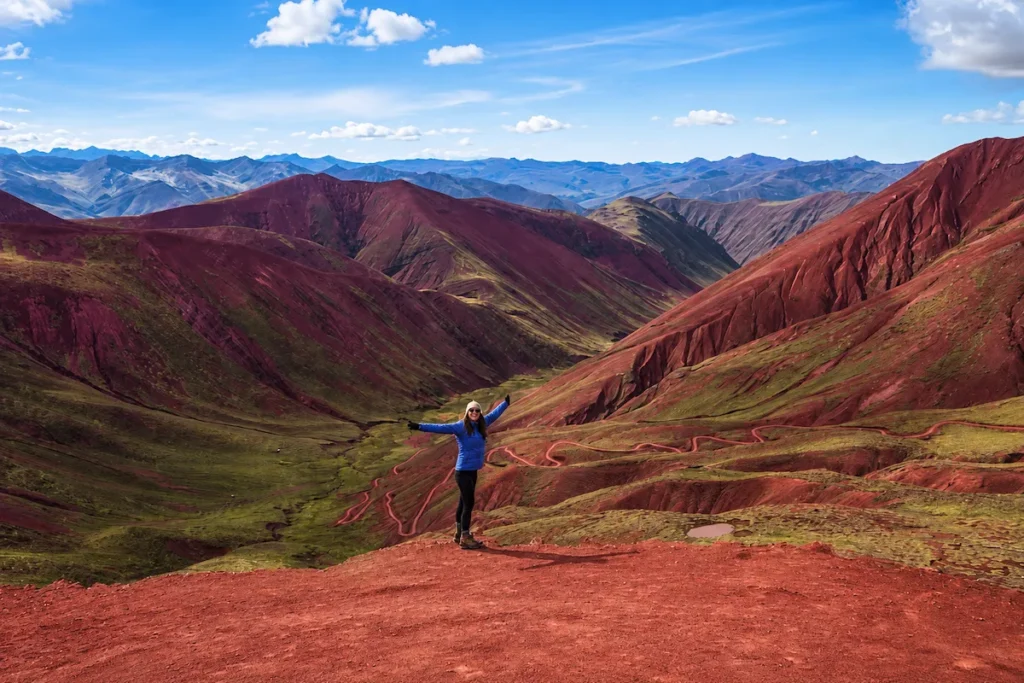
Its name comes from the intense reddish and rust-colored tones that cover much of the surrounding terrain. Instead of the multicolored stripes associated with Rainbow Mountain, Red Valley is dominated by broad slopes in shades of red, orange, brown, and ochre.
The landscape is almost completely treeless due to the altitude. From the trail, you can see rolling red mountains stretching into the distance, with snow-covered peaks occasionally appearing on the horizon.
It feels remote, open, and dramatically different from the greener valleys found closer to Cusco.
Why Is Red Valley Red?
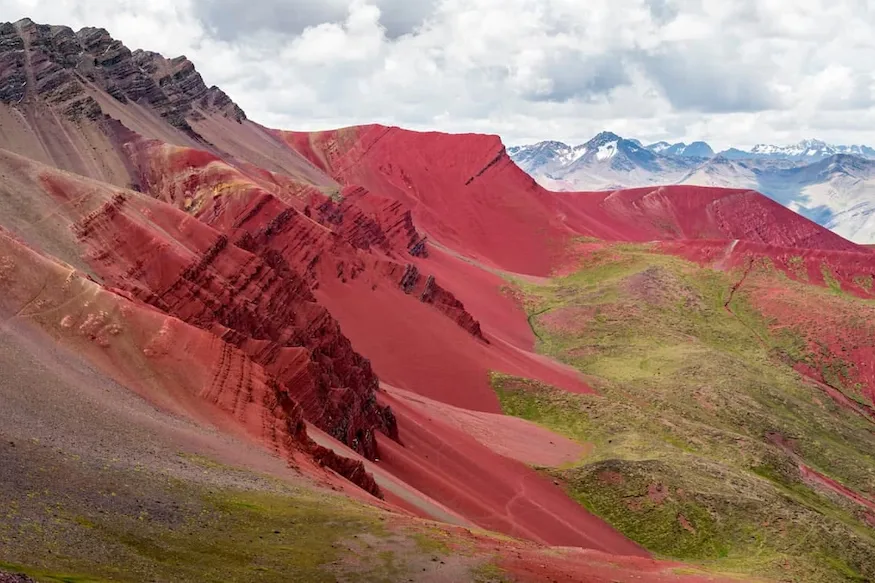
The unusual color of Red Valley is the result of its geological composition.
The mountains and soil contain mineral-rich sediments, particularly materials containing iron. Over long periods, exposure to oxygen and environmental conditions caused these minerals to oxidize.
This oxidation produces the reddish tones visible across the landscape.
Similar geological processes are responsible for many of the colors found around Rainbow Mountain, although the concentration and distribution of minerals are different.
That is why Vinicunca displays several distinct colors while Red Valley appears predominantly red.
Where Is Red Valley Peru?
Red Valley is located in the Cusco region of southern Peru, near Vinicunca and within the spectacular high-Andean landscapes associated with the Ausangate mountain range.
It is roughly 100 kilometers from Cusco by road, although the exact distance depends on the route used.
Most travelers reach the area by traveling from Cusco toward the Rainbow Mountain trailhead and then hiking to Vinicunca. From there, Red Valley can be visited as an additional section of the hike.
Because of its remote location, Red Valley is generally visited as part of a full-day excursion from Cusco rather than as an independent destination.
Red Valley Altitude
Red Valley sits at approximately 5,000 meters (16,400 feet) above sea level, depending on the section of the trail you visit.
This makes altitude one of the most important factors to consider before hiking here.
The amount of walking may not seem extreme for experienced hikers, but physical effort becomes significantly more demanding above 4,500 meters.
At this elevation, the air contains much less available oxygen than at sea level.
Travelers may experience:
- Shortness of breath
- Headaches
- Fatigue
- Dizziness
- Increased heart rate
- Loss of appetite
For this reason, spending at least a couple of days acclimatizing in Cusco or the Sacred Valley before attempting the hike is highly recommended.
Red Valley and Rainbow Mountain
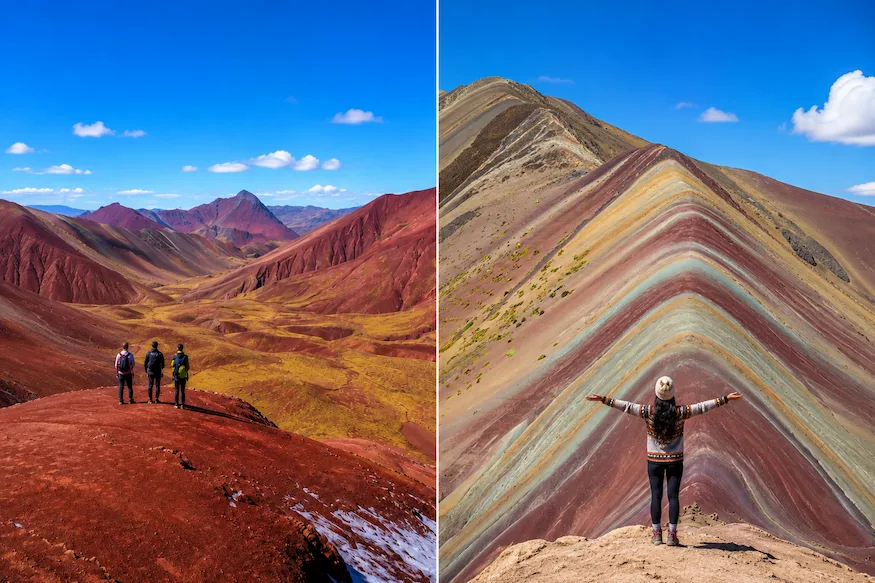
One of the biggest advantages of visiting Red Valley is its proximity to Rainbow Mountain (Vinicunca).
You do not normally need to organize two separate trips.
After reaching the Rainbow Mountain viewpoint, hikers can continue toward the Red Valley trail instead of immediately returning along the standard route.
The two landscapes are surprisingly different.
Rainbow Mountain is famous for its narrow bands of yellow, red, green, lavender, and other mineral colors.
Red Valley, by comparison, is much larger and more uniform. Its appeal comes from the scale of the scenery: enormous red slopes, winding trails, distant mountains, and very little development.
If Rainbow Mountain is the iconic photograph, Red Valley is often the place where travelers can slow down and appreciate the surrounding landscape.
Is Red Valley Worth Visiting?
For most travelers who are already hiking Rainbow Mountain, yes, Red Valley is worth visiting.
The additional hike allows you to experience a completely different landscape without organizing another full-day excursion from Cusco.
There are several reasons to include it.
Fewer Visitors
Rainbow Mountain can become busy, especially during the most popular travel months.
Red Valley generally receives considerably fewer visitors.
Once you leave the main Vinicunca viewpoint, the atmosphere can change quickly. Trails become quieter and the landscape feels considerably more remote.
Incredible Andean Landscapes
Red Valley is not just one viewpoint.
The attraction is the entire landscape.
Red mountains extend across the horizon while trails cut through valleys surrounded by high-altitude grasslands and rugged peaks.
Excellent Photography
The contrast between the red earth, blue sky, white clouds, green ichu grass, and distant snow-covered mountains creates excellent conditions for landscape photography.
Two Destinations in One Day
Because Red Valley is located beside Rainbow Mountain, both destinations can usually be experienced during the same excursion from Cusco.
History and Cultural Importance of the Area
The region surrounding Red Valley has been inhabited and used by Andean communities for generations.
Long before Rainbow Mountain became internationally famous, these high-altitude territories formed part of traditional pastoral landscapes.
Local communities have historically relied on animals such as alpacas and llamas, which are well adapted to the harsh conditions of the high Andes.
The mountains themselves also hold deep cultural significance.
In traditional Andean beliefs, important mountains are often regarded as Apus—powerful mountain spirits associated with protection, water, fertility, and the natural world.
One of the most important mountains in this part of Cusco is Ausangate.
Rising to more than 6,300 meters above sea level, Ausangate is one of the highest mountains in Peru and has enormous spiritual significance for communities throughout the region.
Visiting Red Valley therefore means entering not only a remarkable geological landscape but also a territory shaped by centuries of Andean culture.
Red Valley Hike
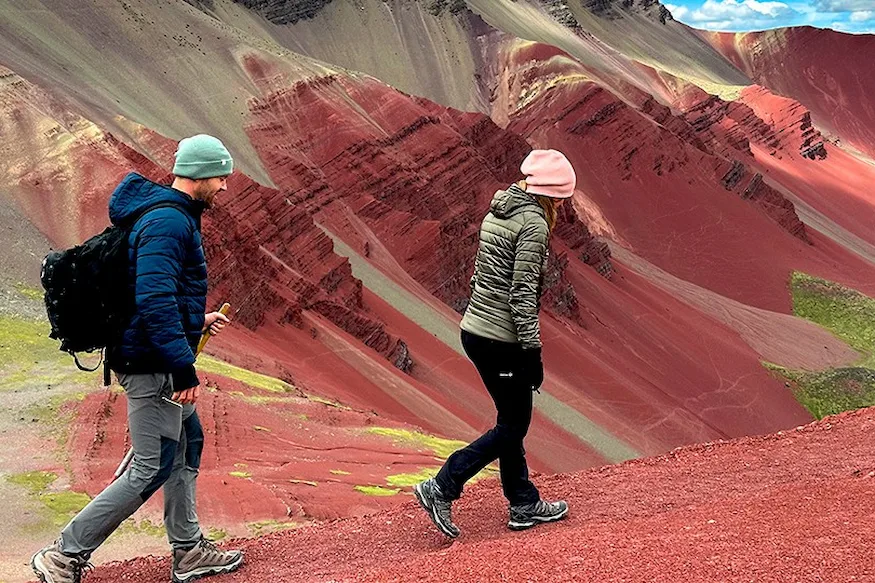
The Red Valley hike is usually completed as an extension of the Rainbow Mountain trek.
After visiting Vinicunca, hikers follow a separate trail toward the valley.
The route climbs and descends through open mountain terrain before revealing increasingly dramatic views of the red-colored hills.
The exact distance and route can vary depending on trail conditions, access points, and how the excursion is organized.
The main challenge is not technical difficulty.
It is the altitude.
Even relatively short uphill sections can feel demanding around 5,000 meters above sea level.
Walking slowly and maintaining a steady pace is much more effective than trying to hike quickly.
How Difficult Is Red Valley?
The Red Valley hike can generally be considered moderate to challenging, primarily because of the elevation.
The trail itself does not require technical mountaineering experience.
However, hiking close to 5,000 meters places considerable stress on the body.
Difficulty also changes according to:
- Your level of acclimatization
- Weather conditions
- Physical fitness
- Trail conditions
- Walking pace
- Previous high-altitude experience
Someone accustomed to hiking at altitude may find the route relatively manageable.
For a traveler arriving directly from sea level, the same trail can feel extremely demanding.
Best Time to Visit Red Valley Cusco
The most favorable period for visiting Red Valley is generally during the dry season from May through October.
During these months, there is a greater chance of clear skies and stable hiking conditions.
May to August
These months typically offer some of the clearest mountain views.
Days can be sunny, but early mornings and evenings are very cold.
June and July are particularly popular months for traveling around Cusco.
September and October
These months can also provide excellent hiking conditions while marking the gradual transition toward the wetter part of the year.
November to March
This is the main rainy season in the Cusco region.
The mountains can still be visited, but rain, clouds, mud, and reduced visibility are more common.
Weather at this altitude can change extremely quickly regardless of the season.
A sunny morning does not guarantee a clear afternoon.
What Is the Weather Like?
Red Valley has a cold high-mountain climate.
Because the landscape sits close to 5,000 meters above sea level, temperatures can change rapidly throughout the day.
You may experience strong sunshine followed by clouds, wind, rain, hail, or even snow.
Solar radiation is also intense at this elevation.
The temperature can feel warm while walking under direct sunlight and become extremely cold once clouds or wind arrive.
For that reason, dressing in layers is essential.
How to Get to Red Valley from Cusco
Most travelers visit Red Valley through the same transportation route used for Rainbow Mountain.
The journey normally begins very early in Cusco.
From the city, vehicles travel south through the Andean countryside before continuing toward the communities and mountain roads leading to the Vinicunca area.
The final section is reached on foot.
Because Red Valley is an extension of the Rainbow Mountain route, travelers normally hike toward Vinicunca first and then continue into Red Valley.
Public transportation directly to the trail is limited and logistics can be complicated for travelers unfamiliar with the region.
For this reason, organized transportation is the most common way to visit.
Red Valley Entrance Fee
Red Valley may require a separate local entrance payment from the fee charged for access to Rainbow Mountain.
These payments are generally managed locally and can change.
Travelers should therefore carry Peruvian soles in cash, preferably in smaller denominations.
Do not assume that the Rainbow Mountain entrance automatically includes access to Red Valley.
It is a good idea to confirm current fees before departure.
How Long Do You Need at Red Valley?
Red Valley is normally visited during the same day as Rainbow Mountain.
The additional hiking time depends on the exact trail, pace, weather, and stopping time for photographs.
Travelers should avoid planning the day too tightly.
At this altitude, walking speed is unpredictable, and even fit hikers may need frequent breaks.
The complete excursion from Cusco should be considered a full-day activity.
What to Bring to Red Valley
Conditions in the high Andes can change quickly, so packing properly makes a significant difference.
Bring:
- Warm jacket
- Waterproof or wind-resistant outer layer
- Comfortable hiking shoes
- Long hiking pants
- Hat or cap
- Gloves
- Sunglasses
- Sunscreen
- Water
- Small snacks
- Personal medication
- Small backpack
- Cash in Peruvian soles
- Rain protection during wetter months
A reusable water bottle is preferable to carrying multiple disposable plastic bottles.
Tips for Visiting Red Valley
Acclimatize Before the Hike
Avoid making Rainbow Mountain and Red Valley your first activity immediately after arriving in Cusco.
Give your body time to adapt to the elevation.
Walk Slowly
There is no advantage to rushing at 5,000 meters.
Take short steps and maintain a comfortable rhythm.
Drink Water
High altitude and intense sunlight can contribute to dehydration.
Drink regularly throughout the hike.
Bring Cash
Local entrance fees and small purchases may require cash.
Card payments should not be expected in remote mountain areas.
Protect Yourself From the Sun
UV radiation is extremely strong at high elevation.
Sunscreen, sunglasses, and a hat are essential even when temperatures feel cold.
Prepare for Sudden Weather Changes
Carry layers rather than relying on one heavy piece of clothing.
Mountain conditions can change within minutes.
Respect Local Communities
The trails cross landscapes managed and inhabited by local Andean communities.
Follow designated routes, respect local rules, and avoid leaving rubbish behind.
Red Valley vs Rainbow Mountain
Although the two attractions are located beside each other, the experience is different.
| Red Valley | Rainbow Mountain |
|---|---|
| Dominated by red and rust-colored landscapes | Famous for multiple mineral colors |
| Generally quieter | Usually receives more visitors |
| Broad valley and mountain scenery | Famous for one iconic mountain viewpoint |
| Excellent for extended hiking | Main attraction of the area |
| Feels more remote | More developed tourism infrastructure |
There is no real need to choose between them.
For travelers with enough energy and proper acclimatization, visiting Rainbow Mountain and Red Valley together provides a much more complete experience of the region.
Can You Visit Red Valley Without Rainbow Mountain?
Technically, routes through the surrounding highlands may provide alternative access, but for most visitors this is unnecessarily complicated.
The simplest and most practical option is to combine Red Valley with Rainbow Mountain.
They are close enough that visiting both during the same excursion makes far more sense than traveling from Cusco twice.
Can Beginners Hike Red Valley?
You do not need to be an expert trekker to visit Red Valley.
However, beginners should not underestimate the altitude.
A traveler with reasonable fitness who has acclimatized properly can often complete the hike successfully by walking slowly and taking breaks.
The experience becomes considerably harder if you are poorly acclimatized.
Your ability to hike comfortably at sea level does not necessarily predict how your body will respond around 5,000 meters.
Red Valley Photography Tips
Red Valley is one of the most photogenic landscapes near Cusco.
Wide-angle lenses work particularly well because the scale of the valley is one of its defining features.
For better photographs:
- Include hikers or llamas for scale.
- Use winding trails as leading lines.
- Photograph contrasting patches of red earth and green vegetation.
- Look for distant snow-covered mountains.
- Protect camera equipment from dust and sudden rain.
- Avoid walking off established trails just to get a photograph.
Clouds can actually improve the landscape by creating shadows and texture across the mountains.
Responsible Travel in Red Valley
Red Valley is a fragile high-altitude ecosystem.
Vegetation grows slowly in these conditions, and damage caused by visitors can take a long time to recover.
Stay on established trails whenever possible.
Do not leave food wrappers, plastic bottles, tissues, or other rubbish behind.
Avoid disturbing alpacas, llamas, and other animals.
Travelers should also remember that tourism takes place on land connected to local communities. Entrance payments and locally provided services can contribute directly to families living in these remote areas.
Responsible tourism helps ensure that the landscape remains protected as visitor numbers increase.
Frequently Asked Questions About Red Valley Peru
Is Red Valley near Rainbow Mountain?
Yes. Red Valley is located beside the Rainbow Mountain area and is commonly visited as an additional hike after reaching Vinicunca.
How high is Red Valley in Peru?
The hiking area reaches approximately 5,000 meters (16,400 feet) above sea level, although elevation varies depending on the exact section of the route.
Is Red Valley harder than Rainbow Mountain?
It adds additional walking after reaching a very high altitude. The terrain itself is not highly technical, but fatigue and elevation can make the extension challenging.
Can I visit Rainbow Mountain and Red Valley in one day?
Yes. Combining both attractions during a full-day trip from Cusco is the most common way to visit Red Valley.
Do I need hiking experience?
Technical hiking experience is not required, but reasonable fitness and proper acclimatization are strongly recommended.
Is Red Valley crowded?
It generally receives fewer visitors than the main Rainbow Mountain viewpoint, although visitor numbers vary by season and time of day.
Why is Red Valley red?
Its reddish appearance comes primarily from mineral-rich geological formations containing iron that have undergone oxidation over long periods.
What should I wear?
Dress in layers and bring warm clothing, a waterproof or wind-resistant jacket, hiking shoes, sunglasses, sunscreen, and a hat.
Is Red Valley open all year?
The region can generally be visited throughout the year, but access and trail conditions can be affected by heavy rain, snow, road conditions, or decisions made by local communities.
Final Thoughts
Red Valley Cusco deserves much more attention than it receives.
Rainbow Mountain may be the reason most travelers arrive in this remote corner of Peru, but Red Valley reveals how extraordinary the entire surrounding landscape really is.
Its enormous red hills, high-altitude trails, grazing alpacas, distant peaks, and relative solitude create an experience that feels distinctly different from the busy Vinicunca viewpoint.
If you are already planning to hike Rainbow Mountain, are properly acclimatized, and still have enough energy after reaching the viewpoint, adding Red Valley Peru is one of the best ways to make the journey even more memorable.
It is not simply an extra viewpoint.
It is another side of the Peruvian Andes.
